
Blog
Extractor Fan Backdraft Shutter: Why You Need One


If an extract route terminates outdoors, backdraft protection belongs in the design. That does not mean every system needs a separate extractor fan backdraft shutter. The needed function may already be inside the fan, in an inline damper, or in the external wall or roof vent.
The real question is whether the system can stop reverse flow, cold-air entry, odours, and inter-branch air transfer in the states that matter: normal running, shutdown, power loss, and service.
Quick answer
For residential extract systems that vent outdoors, backdraft control is generally good engineering. You usually need the function, not necessarily a separate physical shutter. Check first whether the fan, duct accessory, or external vent already provides one-way airflow control before adding another damper.
A separate shutter is only useful when the installed system still allows reverse flow, shared-duct cross-flow, or shutdown leakage. It is not automatically better to add more dampers.
Table of contents
- Why outdoor extract needs backdraft protection
- What goes wrong when it is missing or failed
- Where the protection may already exist
- When not to add another shutter
- Intermittent versus continuous ventilation
- Supported damper types and placement
- Diagnostic table
- Checking, replacement, and redesign
- FAQ
Why outdoor extract needs backdraft protection
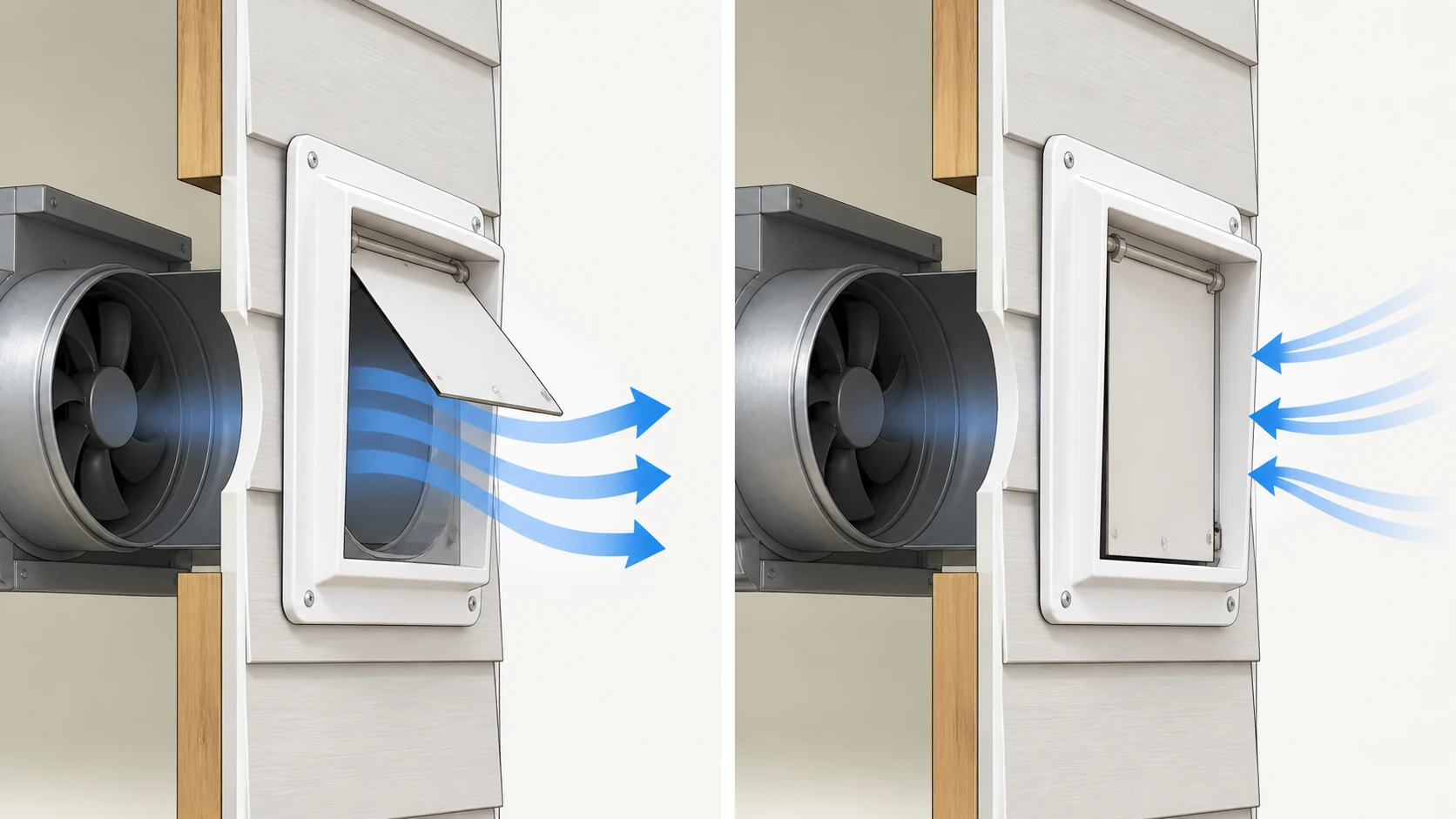
An outdoor extract route is exposed to wind pressure, stack effect, and indoor-outdoor pressure differences. When the fan stops, those forces can pull air backward through the duct instead of letting it stay still. A backdraft damper is a one-way airflow device, so its job is to stop that reverse movement when the fan is not actively extracting.
For a homeowner, the effect is usually felt as a cold draught, noise from a fluttering flap, or unwanted smell transfer. In shared exhaust systems, the problem can also be air moving from one branch into another.
| Law / guidance / engineering | What it means for the reader |
|---|---|
| Law | Country rules can vary. Do not assume a Europe-wide rule that every extract route must have a separate shutter. |
| Guidance | Building-science and manufacturer guidance both support backdraft control where reverse flow is possible. |
| Engineering recommendation | Provide the one-way airflow function somewhere in the system if the outdoor route can backflow. |
Local law varies by country and must be checked for the specific project. Standards and guidance describe accepted engineering practice, while manufacturer instructions govern the exact device or system you are installing. HavenPoint’s position here is a practical engineering recommendation, not universal law.
What goes wrong when backdraft protection is missing or failed
Missing or failed backdraft control can create several practical problems. The most obvious is reverse flow: outdoor air enters the duct when the fan is off. That can cool the room, disturb comfort, and in some layouts bring in moisture or contaminants.
A second problem is inter-zone air transfer. If multiple fans share a duct or a common exhaust path, one fan can push air through another branch when that branch is idle. That is why shared exhausts need explicit cross-flow prevention.
A third problem is performance loss. Every added damper, bend, cap, or restriction increases resistance. If the fan was not selected for the final system resistance, the delivered airflow can fall below what the installation was meant to achieve.
Where the backdraft function may already exist
Do not assume the shutter must be a separate part on the duct. The needed function may already be built into the fan housing, an inline damper, the roof or wall vent, or a combined accessory supplied by the manufacturer.
- Fan-integral damper: some extractor fans include one.
- Inline damper: placed in the duct run to control reverse flow at a chosen point.
- External vent damper or cap: built into the external wall or roof outlet.
- System-designed solution: the installation relies on a specific accessory combination, not a second shutter added later.
If the manufacturer already provides the one-way function, adding another shutter may only add resistance and maintenance risk. That is why the design question comes before the product question.
If your bathroom fan is not removing humidity, check the airflow path and damper condition before replacing parts blindly.
When not to add another shutter
Do not add a second backdraft shutter just because one already exists somewhere in the system. More dampers are not automatically better. If the system already has effective reverse-flow control, another device can create extra resistance, noise, sticking risk, and airflow loss.
You should be cautious about adding another shutter when:
- the fan already has an integral backdraft flap;
- the external vent cap already includes a one-way damper;
- the fan is marginal on airflow and the added pressure loss may matter;
- the duct is short and simple, with no proven reverse-flow issue;
- the manufacturer instructs a specific arrangement that would be upset by extra parts.
HavenPoint engineering recommendation: verify the installed airflow path and backdraft function first, then decide whether the problem is missing protection or a failed/poorly placed component.
Intermittent versus continuous ventilation
Intermittent extract systems are more exposed to backdrafting because they spend more time idle. During normal operation they are moving air outward, but the backdraft question reappears the moment the fan stops, loses power, or is isolated for service. That shutdown state is where passive reverse-flow control matters most.
Continuous or background-plus-boost systems behave differently during normal running. They may reduce the time that the extract route is fully idle, but they do not remove the need to think about shutoff, external-vent leakage, or service states. Power loss, maintenance, control faults, and any periods without airflow can still leave a path open to reverse flow.
- Normal continuous/background operation: outward airflow may reduce some reverse flow, but the installed control strategy still determines how the route behaves.
- Complete shutdown: with the fan stopped, the extract route needs an effective closed-state backdraft-control function somewhere in the designed system.
- Power loss or control fault: active airflow or a powered damper cannot be assumed, so the documented fail position and passive components matter.
- Service or isolation: the unit may be deliberately stopped; the manufacturer’s system design and any integrated or controlled dampers govern the safe off-state arrangement.
Continuous systems may still need backdraft control at shutdown or during power loss. Normal airflow can reduce some reverse flow, but it does not prove protection in stopped states. The real design question is whether integrated or controlled dampers, together with the manufacturer’s system design, govern the off-state behavior correctly.
So the design task is not “add a shutter to every fan”. The task is to make sure the specific control strategy still prevents reverse flow in the real operating states of the installation.
Supported damper types and how they differ
The right type depends on where the reverse-flow risk sits and how the fan is meant to operate. The table below is a practical comparison, not a universal product ranking.
| Type | Typical use | Main trade-off |
|---|---|---|
| Gravity or self-acting flap | Simple passive shutoff | Can be sensitive to orientation, contamination, or weak opening force |
| Spring-loaded damper | Passive shutoff where a firmer close is wanted | Adds resistance; the fan must still overcome it |
| Motorized damper | Controlled closure or system coordination | More complexity and more service points |
| External vent cap with built-in damper | Outdoor termination | Must match the duct layout and weather exposure |
Placement, orientation, access, and resistance

Backdraft control must be placed where it can actually stop reverse flow at the shutdown boundary. That may be at the fan outlet, in the duct branch, in an inline section, or at the external vent hood. The correct location depends on the system architecture.
Orientation matters. A flap installed in the wrong direction, or a damper that is not aligned with the intended airflow, can restrict opening and reduce airflow. Duct routing also matters: a simple, straight route is usually easier on the fan than a heavily restricted one.
Service access is equally important. If the damper cannot be inspected, cleaned, or replaced without damaging the duct or roof/wall detail, the chance of a long-term fault increases. In cold climates, insulation continuity and condensation detailing around the external vent or damper should also be checked.
A damper must also suit the fan’s operating point. If the shutter creates too much resistance, the fan may still run but deliver less air than intended. This is the main reason extra dampers should not be added casually.
Diagnostic table: what the symptom usually means
| Symptom | Likely cause | What to check | Appropriate action |
|---|---|---|---|
| Cold draught at idle | Reverse flow through the duct | Does the fan, external vent, or duct already have a working one-way flap? | Repair or add backdraft control at the correct location |
| Wind rattle | Flap oscillating in pressure changes | Fit, orientation, wear, and external-vent exposure | Check installation and consider a better-suited external vent or damper |
| Incomplete opening | Stiction, fouling, weak opening force, or misalignment | Move the flap by hand where accessible; inspect for dirt or distortion | Clean, re-seat, or replace the damper |
| Weak airflow after added damper | Extra pressure loss | Was the fan selected for the final duct resistance? | Remove unnecessary restriction or redesign the system |
| Shared-duct odour or air transfer | Cross-flow between branches | Does each branch have its own backdraft control? | Add branch-level backdraft prevention or separate the exhaust paths |
| Sticking after idle periods | Contamination, wear, or installation strain | Access, cleanability, and flap freedom | Service or replace the damper |
| Icing or condensation at the external vent | Cold-climate detailing issue | Insulation continuity and cold-bridge details | Improve detailing; verify manufacturer instructions |
Practical example
A bathroom fan in a detached house vents through a short duct to an external wall cap. The owner feels cold air when the fan is off. In that case, the problem may be that the fan has no effective backdraft control, or that the wall vent is leaking more than expected. The right fix is not automatically a second shutter; first confirm where the one-way function is supposed to be and whether it is actually working.
By contrast, if two extract fans share one duct, one fan can push air through the other branch. That is a design problem, not just a comfort issue, and each branch needs its own cross-flow prevention strategy.
Common mistake
The most common mistake is buying and adding a shutter before checking whether the system already has one. The second mistake is assuming any damper is acceptable even if it raises resistance enough to reduce airflow or if it cannot be serviced later.
HavenPoint Expert Tip
Look at the complete shutdown path: fan, duct, external vent, and any shared branches. If reverse flow is stopped only at the external vent, make sure the duct between the fan and external vent does not create another path for odours, drafts, or cross-flow. Good design solves the actual airflow problem, not just the visible part.
Checking, replacement, and redesign
If you suspect backdraft failure, check the system in this order: identify where the function should be, confirm whether it already exists, inspect whether the damper moves freely, and then decide whether the issue is a failed part or a poor layout. That sequence prevents unnecessary replacement work.
Replace the damper if it sticks, rattles excessively, stays partially open when it should close, or cannot be cleaned or accessed properly. Redesign the route if the fan is clearly underperforming because the installed resistance is too high or the exhaust path is too complex for the selected fan.
FAQ
Do I always need a separate extractor fan backdraft shutter?
No. You need the backdraft-control function, but it may already be built into the fan, duct accessory, or external vent cap.
What is the main job of a backdraft damper?
Its job is to allow airflow in one direction and block reverse flow when the fan is off.
Why can a second damper make airflow worse?
Because every extra restriction adds resistance. If the fan was not selected for that final resistance, airflow can drop.
Are shared exhaust ducts a special case?
Yes. Shared ducts can transfer air between branches unless each branch has appropriate backdraft control.
What should I check first if I feel a cold draught from the fan?
Check whether there is already a flap or damper, whether it closes properly, and whether the external vent is the source of the reverse flow.
Should continuous ventilation systems ignore backdraft protection?
No. Continuous systems may reduce idle time, but shutdown, power-loss, and service states still matter.
Conclusion
An extractor fan backdraft shutter is best understood as a design function, not automatically as a separate part. In residential extract systems that vent outdoors, the goal is to stop reverse flow without over-restricting the fan. Check where the function already exists, confirm it works in shutdown, power-loss, and service states, and only add another shutter when the actual system design needs it.