
Blog
How to Reduce Humidity in a Bedroom

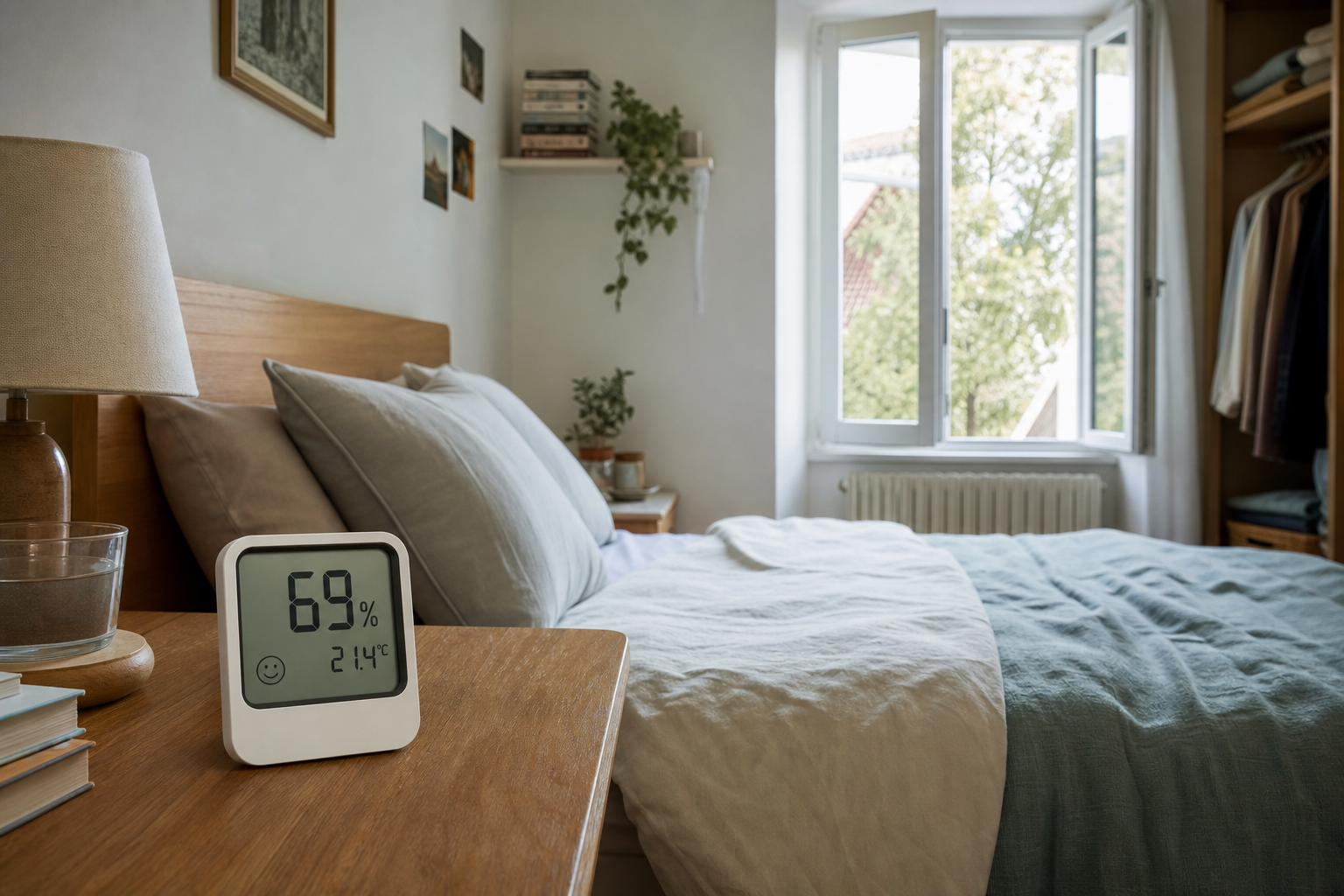
If you want to reduce humidity in a bedroom, start by finding the cause: overnight moisture from people, poor ventilation, cold surfaces, or damp entering the room from elsewhere. In many European homes, a practical comfort range is often around 40–60% relative humidity, but the right target depends on the building, season, and ventilation system.
The safest approach is usually to reduce moisture at the source, ventilate at the right time, and keep the bedroom warm enough to limit condensation. A dehumidifier can help when those measures are not enough, but it will not fix leaks, thermal bridges, or mold by itself.
Quick Answer
To lower humidity in a bedroom, first measure it over several nights, then check whether the main problem is moisture generation, weak ventilation, or cold surfaces. If the room stays humid after reasonable ventilation and heating, a dehumidifier may be appropriate. If condensation is concentrated on persistently cold surfaces, the building envelope may also need investigation.
- Target range: often about 40–60% RH for comfort, with some EU guidance allowing wider bands depending on the building.
- Best first step: reduce moisture sources and improve ventilation.
- Best backup: a dehumidifier when outdoor air is already humid or ventilation is insufficient.
- Watch out for: condensation, mold, and over-drying.
Table of Contents
- Why bedroom humidity becomes too high
- How to measure bedroom humidity accurately
- Practical ways to reduce humidity in a bedroom
- When ventilation, heating, or a dehumidifier is the right solution
- Common mistakes that make bedroom humidity worse
- Real-world example
- HavenPoint expert tip
- FAQ
- Conclusion
Why bedroom humidity becomes too high
A bedroom often gets more humid overnight because people add moisture to the air through breathing and perspiration, while windows and doors are often kept closed. If the room is small, poorly ventilated, or already cool, that moisture can show up quickly as higher relative humidity or window condensation.
High humidity is not just a comfort issue. It can increase condensation risk, support mold growth on cold surfaces, and make dust-mite conditions more favorable. Damp buildings are also associated with respiratory symptoms and asthma, although sensitivity varies from person to person.
| Likely cause | What you may observe | What it suggests |
|---|---|---|
| Night-time occupancy | Humidity rises after sleep, then falls later in the day | Moisture from breathing and perspiration is a major factor |
| Poor ventilation | Stuffy air, little RH change, windows may fog | Moist air is not being replaced effectively |
| Cold surfaces | Condensation on glass, corners, or external walls | Surface temperature may be too low for the moisture level |
| Building dampness | Persistent damp smell, repeated mold spots, staining | There may be leaks, rising damp, or thermal-bridge problems |
How to measure bedroom humidity accurately
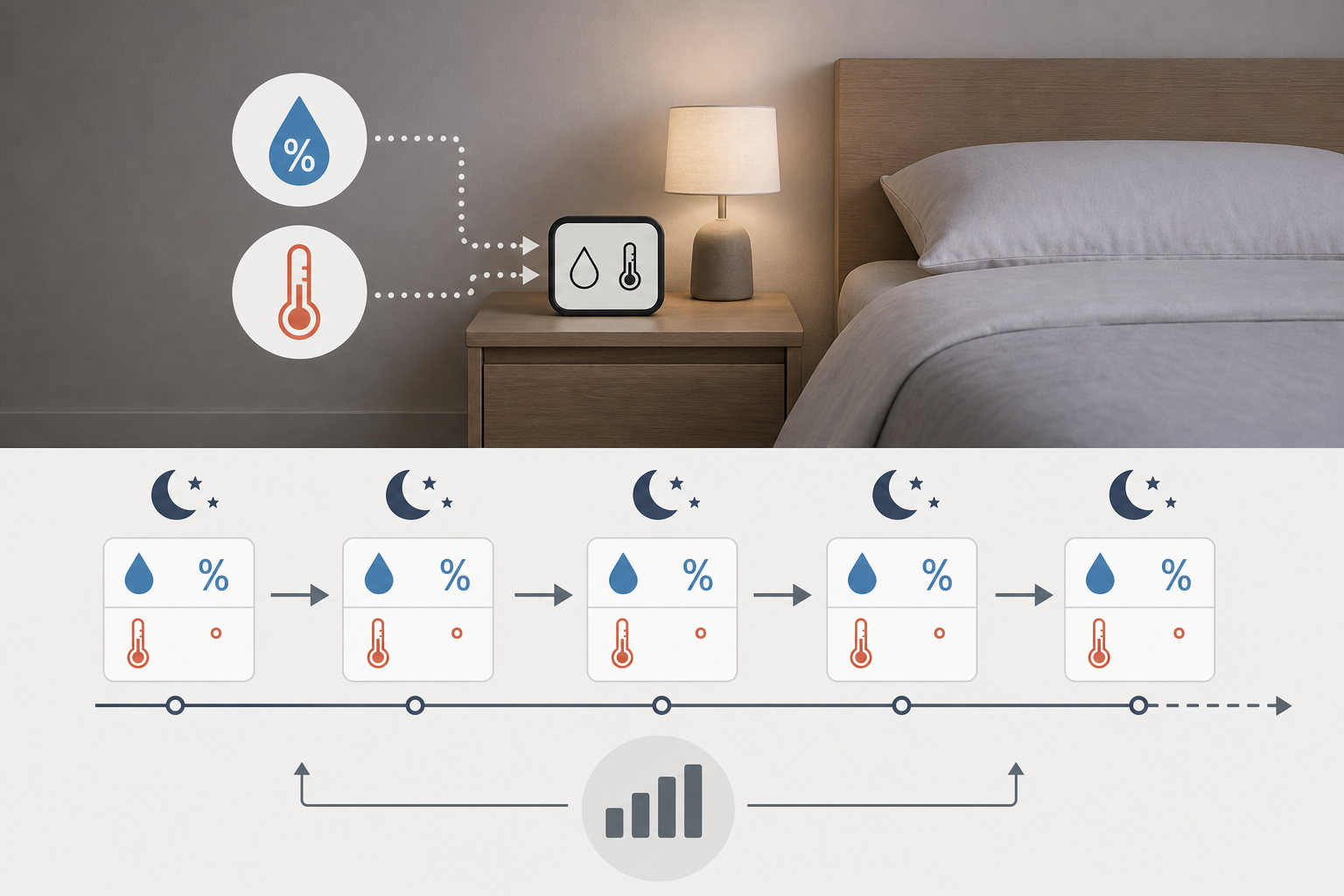
Use a hygrometer and check both relative humidity and room temperature. A single reading can be misleading, so measure at the same time over several nights and compare the results with what happens after ventilation or heating.
- Place the sensor away from windows, radiators, and direct airflow.
- Take readings in the morning and evening for a few days.
- Look for patterns, not just one number.
- Check whether condensation appears even when RH seems moderate.
Relative humidity depends on temperature, so the same moisture level can read differently in a warmer or cooler room. That is why heating can lower RH without actually removing water from the air: it mostly changes the relationship between moisture and temperature, and it can help reduce condensation on surfaces.
Practical ways to reduce humidity in a bedroom
1. Reduce moisture at the source
If humidity is high mainly overnight, start with the obvious moisture sources. Keep wet laundry out of the bedroom, limit storage of damp items, and avoid adding extra moisture from activities that do not belong in the room. If several people sleep in the room, expect a higher overnight load than in a single-occupant room.
2. Improve ventilation at the right time
Ventilation is a first-line response because it replaces moist indoor air with drier outdoor air when conditions are suitable. That said, it works best when the outdoor air actually has a lower moisture load than the indoor air. On humid days or in some climates, ventilation alone may not reduce bedroom humidity enough.
For many homes, short and effective airing can be better than leaving a window open for long periods. The best timing depends on your climate and season, because the same strategy can help in one situation and make the room worse in another.
3. Keep the room warm enough
Heating does not remove moisture, but it can reduce relative humidity and warm cold surfaces that would otherwise attract condensation. If the bedroom is very cool, a modest temperature increase may help stop window misting and reduce the chance of visible damp spots on walls or corners.
4. Use a dehumidifier when ventilation is not enough
A dehumidifier for bedroom use is useful when the room stays too humid despite reasonable ventilation and heating, or when outdoor air is too humid to help. It removes water vapor from the air, but it does not repair leaks, improve insulation, or fix hidden mold sources.
5. Address cold surfaces and building defects
If condensation keeps appearing near windows, external walls, or corners, there may be a thermal bridge, insulation issue, or another building defect. In that case, equipment alone may only treat the symptom. The source of the moisture problem still needs to be corrected.
When ventilation, heating, or a dehumidifier is the right solution

| Solution | Best for | Limitations |
|---|---|---|
| Ventilation | Moist air buildup from sleeping and closed rooms | May be ineffective when outdoor air is already humid |
| Heating | Cold bedrooms with condensation on surfaces | Does not remove water from the room |
| Dehumidifier | Persistent high RH despite ventilation and heating | Does not fix leaks, mold, or insulation defects |
| Building repair | Recurring dampness, stains, or mold in the same places | Requires diagnosis and may need professional assessment |
In practice, the best choice is often a combination. A well-used bedroom may need source control and ventilation most of the time, with a dehumidifier as support during wet weather or in poorly performing rooms. If the room is cold or has repeated condensation, fix that problem early instead of trying to dry the air harder.
Risks of excessive dryness versus excessive humidity
Low humidity is not automatically better. Over-drying can reduce comfort and may irritate the eyes, nose, and throat. That is why a broad comfort band such as roughly 40–60% RH is often used, while some guidance allows wider ranges depending on season and building type.
High humidity has the opposite problem: more condensation, more mold risk, and a greater chance of sleeping in stale, uncomfortable air. The goal is not the lowest possible reading. The goal is stable, manageable humidity with no visible dampness or recurring condensation.
Common mistakes that make bedroom humidity worse
- Using one humidity target for every bedroom and every climate.
- Checking humidity only once instead of over several nights.
- Ventilating more when the outdoor air is already humid.
- Buying a dehumidifier before checking for condensation or leaks.
- Turning the heating very high instead of removing the moisture source.
Real-world example
A bedroom reads 68% RH at 19°C after a night with two occupants and closed windows. The first checks should be whether the room is getting enough air exchange, whether the door is kept shut, whether condensation appears on the window, and whether damp laundry or other moisture sources are nearby. If the bedroom is still above about 60% RH for long periods after reasonable ventilation, a dehumidifier or building diagnosis becomes more relevant than opening the window more often.
HavenPoint expert tip
Do not diagnose bedroom humidity from RH alone. Always pair the reading with temperature and with what you see on the surfaces: foggy glass, damp corners, or mold spots are often more useful clues than the number by itself. That combination usually tells you whether the problem is moisture load, weak ventilation, or a cold-surface issue.
FAQ
What is the ideal bedroom humidity?
A practical target is often around 40–60% relative humidity, but the right range depends on the room, season, and ventilation system. Some European guidance allows wider bands in certain conditions.
Why does humidity rise in a bedroom at night?
People add moisture through breathing and perspiration, and the room is often closed up overnight. That combination can push humidity up quickly, especially in small or poorly ventilated bedrooms.
Should I ventilate a humid bedroom in winter?
Sometimes yes, but only if the outdoor air is suitable and the room will not become colder and more condensation-prone. Short, effective ventilation is usually safer than leaving the room open for long periods.
When is a dehumidifier the better choice?
A dehumidifier is most useful when humidity stays high despite reasonable ventilation and heating, or when outdoor air is too humid to help. It is a support measure, not a fix for leaks or insulation problems.
Can a humid bedroom cause mold?
Yes. Persistent humidity and condensation can support mold growth, especially on cold surfaces like windows, corners, and external walls. Visible mold should be treated as a sign of a moisture problem that needs source correction.
Does heating lower bedroom humidity?
Heating can lower relative humidity and reduce condensation risk, but it does not remove water from the air. It works best together with moisture reduction and ventilation.
Conclusion
To reduce humidity in a bedroom, measure first, then act on the likely cause. For most homes, the best sequence is source control, sensible ventilation, and enough heat to prevent cold-surface condensation. If the room still stays too humid, a dehumidifier can help, but it should not replace a fix for leaks, thermal bridges, or persistent dampness.
Check your bedroom humidity and explore the most suitable ventilation or dehumidification solution for your space. Explore humidity control solutions
References
- European Commission Joint Research Centre — Relative humidity (from EN 16798-1) (PDF)
- REHVA — REHVA Journal: EPBD guidance documents published by European Commission: IEQ parameters and ZEB energy calculations
- World Health Organization — WHO guidelines for indoor air quality: dampness and mould
- NCBI Bookshelf / WHO content — Executive summary – WHO Guidelines for Indoor Air Quality
- NCBI Bookshelf / WHO content — Moisture control and ventilation – WHO Guidelines for Indoor Air Quality
- European Commission — Indoor Air Quality